Streamlining Backend Development with Microservice Template 🚀
In the realm of software development, efficiency, scalability, and maintainability are not just goals — they are essential criteria for…
Streamlining Backend Development with Microservice Template 🚀
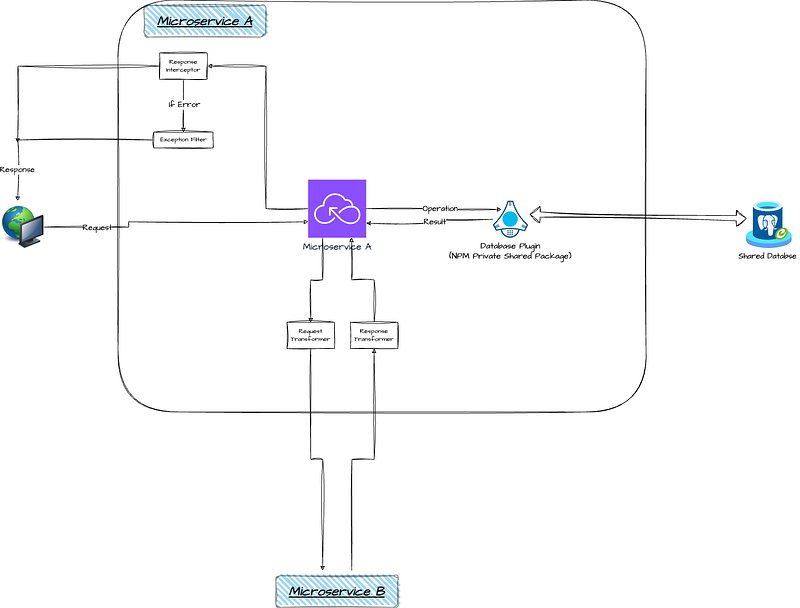
In the realm of software development, efficiency, scalability, and maintainability are not just goals — they are essential criteria for success.
In the one my recent work I had a challenge to build several microservice that can scale, So I invested my time to develop a template which can be used to spin out the microservice abruptly fast.
This template have all common layer like
- Response structure
- Inter and Intra communication with HTTP
- Rabbit MQ for async work
- Swagger generation
- Monitoring and logging
- A common database plugin to extract databse logic out of service
And a lot more feature.
GitHub - gaju91/microservice-v1-template: 🎭 A NestJs Microservice template embedded with HTTP 🕸️…
*🎭 A NestJs Microservice template embedded with HTTP 🕸️ and RabbitMQ 🐇 communication. …*github.com
GitHub - gaju91/shared-module-template: 🧪 Shared module for microservice template 📊, Contains…
*🧪 Shared module for microservice template 📊, Contains code for database 💿 ops and shared entity knowledge …*github.com
Introduction to Microservice Architecture 🏗️
Microservices have become the architecture of choice for developers looking to build scalable and manageable applications. This architectural style involves dividing a single application into small, independently deployable services, each running its own process and communicating via lightweight mechanisms.
Unpacking the Microservice v1 Template 📦
The Microservice v1 Template, crafted with Nest.js and TypeScript, is a robust blueprint for developing scalable and efficient microservices. Let’s dive into its components and how it empowers developers:
Core Technologies 🔧
- Nest.js: A progressive Node.js framework for building server-side applications with ease and efficiency.
- TypeScript: Provides static typing to JavaScript, enhancing developer experience and code quality.
Database Communication Via Plugin 🗄️
Through its integration with a Database Plugin, the template abstracts complex database operations, providing a simplified and maintainable approach to CRUD operations.
External Communication Mastery 🌍
- HTTP Sync with BaseHttpService: Built on NestJS’s
@nestjs/axios, it simplifies making external HTTP requests. - Async Communication with Rabbit MQ: Facilitates message queuing and processing, ensuring robust asynchronous communication.
Swagger for API Documentation 📚
The template incorporates Swagger, an open-source tool for documenting APIs. This integration allows developers to generate interactive API documentation automatically, making testing and frontend integration smoother.
Containerization with Docker 🐳
Containerization is a key feature, with the template offering Docker support out of the box. This allows for easy deployment, scaling, and ensures consistency across development, staging, and production environments.
The Backend Shared Module Plugin: A Closer Look 🔍
The Backend Shared Module Plugin is a TypeScript-based toolkit designed for efficient data management. It leverages TypeORM for database interactions, promoting code reusability and consistency.
Highlights ✨
- Streamlined Database Operations: Simplifies PostgreSQL database interactions.
- Entity Model Centralization: Ensures a coherent approach to database schema management.
- Shared Enums and Constants: Provides a unified way to manage enums and constants across your project.
Seamlessly Integrating the Tools 🛠️
Microservice v1 Template Setup 🚀
- Clone the repository.
- Install dependencies with
npm install. - Configure your
.envfile based on the provided.env.template. - Launch the application with
npm run start.
Utilizing the Backend Shared Module Plugin 🧩
- Add it as a dependency in your
package.json. - Initialize the
DatabaseModulewith your database configuration. - Extend functionality by adding new entities or services as needed.
Extending Functionality and Practical Applications 🌈
These tools are designed to be flexible and adaptable to a wide range of use cases. Whether you’re building user management systems or data processing services, you can easily expand their functionality to meet your specific needs.
Conclusion: Transforming Backend Development 🌟
The combination of the Microservice v1 Template and Backend Shared Module Plugin significantly streamlines the development process. By leveraging these tools, developers can focus more on implementing business logic and less on boilerplate code, leading to faster development cycles and more maintainable codebases. Dive into these resources and elevate your backend development game! 🎉